
Information Asymmetry and the Business of Deception
Scam culture describes a growing social pattern in which deceptive practices are reframed as hustle, innovation, or ambition. What is striking is not only how common these practices have become, but how rarely they are questioned. As scams grow more sophisticated, they increasingly resemble legitimate economic activity. At their core, they reflect an extreme willingness to monetize trust, identity, and social relationships.
For many people, the line between persuasion and manipulation becomes difficult to detect in real time. When the story sounds familiar and the promise feels urgent, the brain often moves faster than reflection. Not because we are careless, but because we are human.
Social Signaling and Decision Formation
Influencer culture reflects a shift in how people decide what to believe and buy. With the rise of Web 2.0, authority moved away from traditional institutions and credentialed experts. People began turning to peers, online personalities, and social networks for guidance. Information became relational rather than institutional.
Brands adapted by prioritizing connection over explanation. What matters most is no longer depth of knowledge, but perceived closeness and confidence. These relationships are parasocial, yet they feel personal enough to shape trust. In this environment, individuals are not just consuming content. They are producing it, sharing it, and reinforcing it.
What often goes unexamined is how little information we actually have when we decide to trust someone online. Expertise is rarely visible. Accountability is diffuse. Influence, however, is unmistakable. Budget Brain exists to slow that moment down. To create space between exposure and action, where intention can replace impulse.
Heuristics, Bias, and Predictable Irrationality
Cognitive biases are mental shortcuts the brain relies on when time, energy, or information is limited. These shortcuts are efficient and necessary. The brain consumes a large share of the body’s energy, so it’s designed to conserve effort whenever possible.
But efficiency comes with tradeoffs. When decisions feel urgent or emotionally charged, shortcuts can quietly steer behavior. Confidence may be mistaken for competence. Familiarity may feel like safety. Popularity may be interpreted as proof.
Budget Brain encourages a pause at this exact point. Not to eliminate shortcuts, but to notice them. Awareness does not remove bias, but it can shift decisions from automatic to intentional.
Theranos as a Case Study in Behavioral Failure
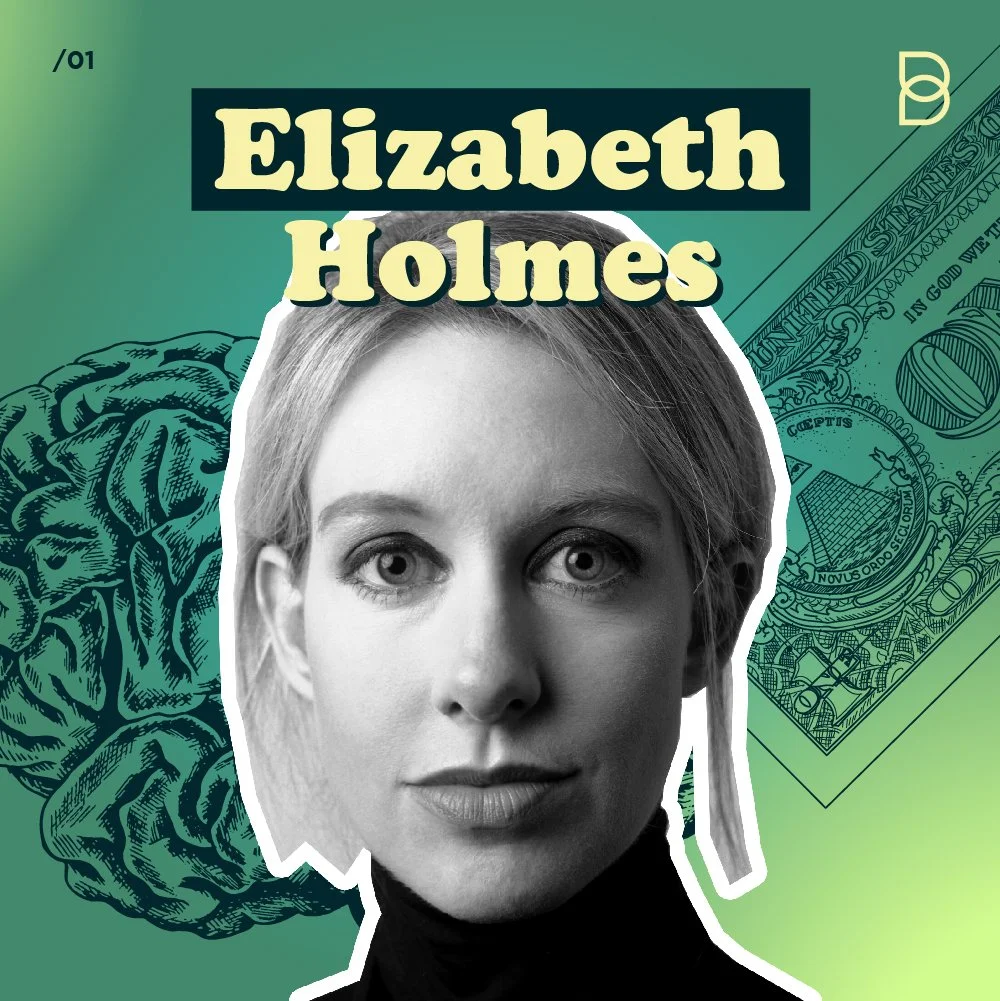
Elizabeth Holmes was born in Washington, D.C. to middle class parents of French and Danish descent. She developed early interests in computer programming and Mandarin Chinese, later attending Stanford University to study chemical engineering. As a student, she worked as a researcher and laboratory assistant. At nineteen, she left Stanford and used her tuition money to fund Theranos.
Theranos promised to revolutionize healthcare by detecting illnesses using small blood samples analyzed by automated devices. The appeal was immediate. Faster results. Easier access. Testing stations in grocery stores and pharmacies such as Walgreens. The vision felt bold, modern, and deeply aligned with public frustration around healthcare inefficiency.
This story activated several powerful mental shortcuts.
Optimism bias made best case outcomes feel more likely than they were. Overconfidence bias amplified trust in Holmes’s certainty and composure. Availability bias made comparisons to famous technology founders easy to recall, crowding out less visible examples of failure. Similarity bias encouraged belief because Holmes looked and sounded like innovators people already admired.
Authority bias added credibility through high profile endorsements, even when those authorities lacked scientific expertise. Social proof completed the loop. As more investors joined, participation itself became evidence. Momentum replaced verification.
Theranos raised approximately seven hundred million dollars and reached a valuation of ten billion dollars. Yet the technology never worked as promised. Scientific validation was absent. Trial and error were replaced with narrative and confidence.
Holmes has since been convicted and sentenced, though the focus should not rest solely on punishment. The more important lesson lies in how easily belief formed long before proof existed.
The Behavioral Path from Belief to Action
The Theranos case illustrates how influence, bias, and urgency intersect. Decisions were not driven by ignorance, but by predictable human tendencies. Under uncertainty, the brain fills gaps with stories. When confidence is visible, doubt recedes. When many people believe something, opting out feels uncomfortable.
Budget Brain is designed for these moments. The moments when you feel pressure to act, invest, spend, or trust. It asks you to notice what is driving the decision. Is it evidence, or is it familiarity. Is it alignment with your values, or fear of missing out.
Breaking habits does not mean avoiding every risk. It means recognizing when your brain is rushing ahead of your intention. Owning every decision begins with awareness. And awareness begins when you slow down long enough to ask why this feels right, right now.
That pause isn’t weakness. It’s strategy.